
SEP
15
2026
Beta User Workshop
Virtual
Join us for an interactive workshop to learn about GP-STOR and get started as a beta user
workshopbetatraining
Features
GP-STOR provides distributed, resilient storage infrastructure designed to accelerate research across the Great Plains region.
14 PB of redundant Ceph object storage plus 384 TB of high-speed solid-state storage designed for AI/ML streaming, simulation output, and instrument data.
Storage resources distributed across the University of Missouri, University of Nebraska, and University of South Dakota for availability and redundancy.
Mounts for OSG and the National Research Platform and a web-based UI.
Virtual office hours, video walkthroughs, and step-by-step guides cultivate an engineering and facilitation workforce across the region.
Stay updated with the latest workshops, trainings, and community events.
Virtual
Join us for an interactive workshop to learn about GP-STOR and get started as a beta user
Kansas State University
Learn how to migrate AI/ML workflows to the Nautilus platform, part of the National Research Platform
Iowa State University
Learn how to migrate AI/ML workflows to the Nautilus platform, part of the National Research Platform
South Dakota State University
Learn how to migrate AI/ML workflows to the Nautilus platform, part of the National Research Platform
Virtual
This webinar will give instructors an introduction to leveraging the large distributed computing resources available through the National Research Platform (NRP)
University of Arkansas
Learn how to migrate AI/ML workflows to the Nautilus platform, part of the National Research Platform
No upcoming events at this time.
Discover the powerful storage infrastructure designed for modern research workflows
14 petabytes of redundant, distributed Ceph object storage provides the scale needed for large-scale research datasets, simulations, and archives.
384 TB of high-speed solid-state storage optimized for streaming data into AI/ML algorithms and out of simulations and instruments in real-time.
Three-site distribution across the University of Missouri, University of Nebraska, and University of South Dakota ensures data availability and redundancy.
Researcher-friendly access through web-based UI, mounts for OSG and NRP, OSDF Origin nodes, and Globus endpoints.

GP-STOR accelerates discovery across diverse scientific domains
The high-speed solid-state tier enables rapid data streaming into ML algorithms, supporting cutting-edge artificial intelligence research workflows.
Efficiently capture and store massive simulation outputs, enabling researchers to focus on analysis rather than data management challenges.
Seamlessly integrate data from research instruments and sensors, with automated pipelines for processing and archival.
Provide students with hands-on experience using modern cyberinfrastructure in classroom settings and research projects.
Building research capacity across the Great Plains
Addresses the unique challenges of deploying advanced cyberinfrastructure in rural regions where resources and awareness of HTC capabilities are emerging.
Cultivates an engineering and facilitation workforce capable of designing and implementing advanced research platforms across the region.
Builds campus research capacity and innovation infrastructure at universities across the Great Plains, including PUIs and tribal colleges.
Supports industrial sectors critical for regional economic development, including agriculture and advanced materials research.
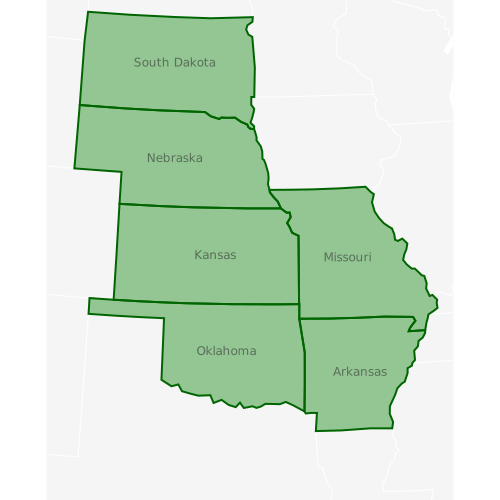
Our development and deployment schedule from infrastructure acquisition through public access and community engagement.
Q4 2024: Infrastructure acquisition
Finalize specifications and procure infrastructure for GP‑STOR.
Q1 2025: Receive hardware
Delivery and rack/cabinet intake at sites; begin inventory and staging.
Q1-Q2 2025: Deploy and configure
Install CEPH clusters across sites, configure replication, pools, and monitoring.
Q2 2025: Deploy storage interfaces
Enable access methods such as a web interface and mounting on National Research Platform.
Q3 2025: Beta users
Onboard early adopters for real-world testing and performance tuning.
Q4 2025: Open access & trainings
Public access opens, training sessions held, and operational support transitions to steady‑state.
Q2 2026: Convene user group
Bring together early stakeholders and beta participants to solicit feedback on service design and policies.
Join GP-STOR today and leverage distributed, resilient storage infrastructure across the Great Plains region.